

National Camera Day 2021
June 29th is National Camera Day! Our work here at Atlantic Exposure would not be possible without cameras. We wanted to celebrate by sharing a bit of the extensive history of the camera and photography along with a fun project we did in the spirit of the day.
Cameras have come a long way since the camera obscura (“dark chamber” in Latin) used for art and entertainment as early as the 4th century BC. It is controversially thought that some master painters of the Renaissance era used camera obscuras to trace scenes prior to painting them.


It was not until the early 1800’s that photography cameras came into existence. Inventor Nicéphore Niépce invented heliography, his name for what is now known as photography. With his invention he created what is credited as the first fixed permanent photograph. Niépce would place an engraving and various chemicals onto different materials, expose it to light, and the light reacted to the chemicals on the plate. The chemical reaction created an image on the plate. The process took 8 hours and was not permanent as the photographs would eventually fade away depending on the materials used. Niépce tried for many years to reduce his exposure times, but ultimately died without seeing any further advances.


After Niépce’s death, his partner Louis Daguerre continued their work, and was successful at reducing exposure time. In 1833, he invented the daguerreotype process using silver plated sheets of copper to produce highly detailed permanent photographs. The daguerreotype is the first successful form of photography as we know it today.


With a successful process in place, the evolution of the camera took off. Panoramic cameras with wide angle lenses made from glass spheres filled with water, stereoscope viewers, and the game changing Kodak celluloid film camera invented by George Eastman all came out in the 50 years after the daguerreotype. In 1900, Eastman took it a step further and introduced the first mass-marketed camera in the world. The small and affordable Brownie camera was incredibly popular and was available for sale until the 1960’s.


Tartan Ribbon, photograph taken by James Clerk Maxwell in 1861. Considered the first durable colour photographic image, and the very first made by the three-colour method Maxwell first suggested in 1855. Maxwell had the photographer Thomas Sutton photograph a tartan ribbon three times, each time with a different colour filter (red, green, or blue-violet) over the lens. The three photographs were developed, printed on glass, then projected onto a screen with three different projectors, each equipped with the same colour filter used to photograph it. When superimposed on the screen, the three images formed a full-colour image. Maxwell's three-colour approach underlies nearly all forms of colour photography, whether film-based, analogue video, or digital. The three photographic plates now reside in a small museum at 14 India Street, Edinburgh, the house where Maxwell was born. Source: Wikimedia Commons
Cameras have evolved with technology to the point where almost everyone now has one in their pocket. There are cities with one on every corner. It has become a staple feature in phones, computers, cars, medical technology, and so much more. You name it, someone has probably put a camera on or in one. Cameras enable us to see the smile on a loved ones face in real time. We can tell stories, share moments, preserve memories, avoid accidents, and explore places we cannot safely go. In its time, the camera has gone from the size of a room to something the size of a grain of sand and able to fit in the smallest of veins. It is an impressive journey that deserves some celebration!


In the spirit of National Camera Day, some of us decided to have some fun with a vintage Brownie camera we have in the office!
Krista


“I decided to have fun and do three different edits of the same photo. The first one is done without any special editing techniques. I love the look of high contrast editing in images that are black and white or with low color, so I chose that for my second edit. Last, it is always fun to see an inverted color version of an image and I think this one looks great that way.”
Maris

“While trying to figure out how I wanted to place the camera strap, I noticed a slight heart shape. This idea popped into my head and with a bit of crafty creativity, came to life! Showing my love for cameras with a picture featuring both seemed very fitting for the project.”
We hope you enjoyed learning more about cameras and celebrating them with us! It was nice having the chance to play around and be creative with cameras, but it is time to get back to what we love to do. Giving the BEST exposure possible to our clients and their properties!

National Nature Photography Day
While the main focus of Atlantic Exposure is architectural photography and real estate photography, how could we resist celebrating National Nature Photography Day? In celebration of this day we wanted to share some of our favorite personal nature photography photos!
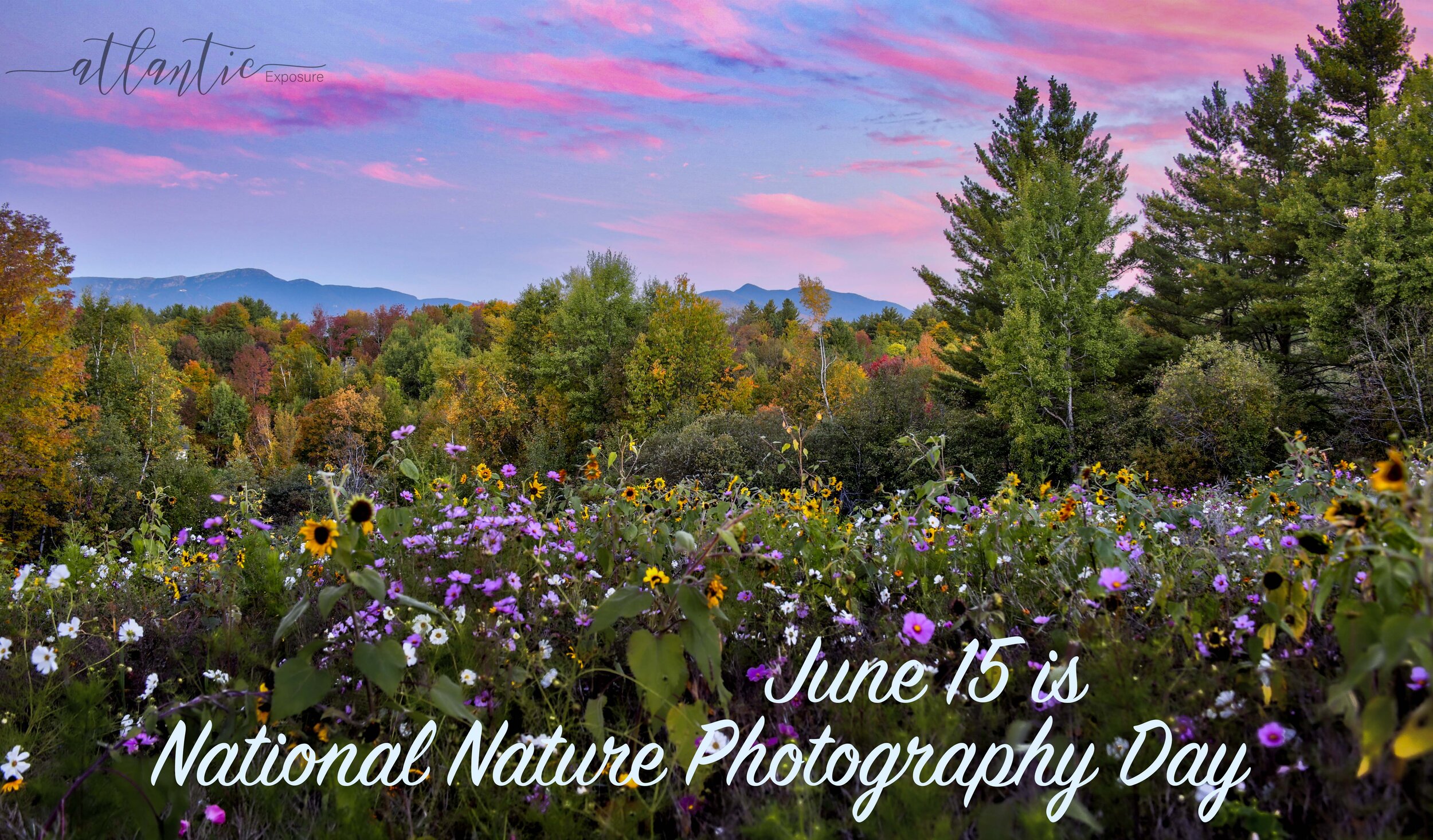
National Nature Photography Day
While the main focus of Atlantic Exposure is architectural photography and real estate photography, how could we resist celebrating National Nature Photography Day? In celebration of this day we wanted to share some of our favorite personal nature photography photos!
In 2006, the American Nature Photography Association (NANPA) celebrated the first Nature Photography Day to celebrate the art of nature photography. It has grown into a worldwide tradition that continues to gain popularity and evolved to spread wildlife conservation awareness as well.
So take a moment to relax from life and appreciate the beauty of nature!
Krista

Waterbury Reservoir, Fall 2018
“The Fall color change in Vermont is one of my favorite times of year. Every fall I make a trip up to take photos and capture the gorgeous contrast of the landscape. This is one of my favorites taken at the Waterbury Reservoir in Fall 2018.” Krista

A lone sailboat on a foggy day in Burlington, Vermont.
“This one was taken at Lake Champlain in Burlington, Vermont. I love that there was a sailboat out enjoying a foggy summer day and how the mountains fade in the fog as they recede.” Krista
Leah

Palm trees in Venice, Florida
“I love everything palm trees and beach related. This photo I took in Venice, Florida always fills me with feelings of bliss.” Leah

A family of geese swimming in Ocean Pines, Maryland
“I could not resist taking a photo of this family of geese in Ocean Pines! Baby geese make me happy and they make me smile every time I see them.” Leah

A blanket of snow in Snow Hill, Maryland
“Snow is not a common occurrence on the Eastern Shore and I found this blanket of snowfall in Snow Hill, Maryland enchantingly beautiful.” Leah
Ryan


“My photos are all taken at a trail in Cape State Park. I often go to this there to unplug from my phone and spend time outside. The park is a historic and unique gem of the Delmarva area. I think these photos really capture it’s shine.” Ryan
Maris


“I absolutely love Great Falls and try to sneak out there whenever I am in the area visiting family or friends. It is so majestic and every trip is a breathtaking adventure. The water was particularly rough this visit and while the photos translate the beauty, they do not translate the deafening chaos of the water rushing that day. The second photo is kind of generic, but I love the intrigue the lone mystery kayak adds to it. How did it get there? When did it get there? Is the owner of the kayak okay? Where is the kayak today? A subtle reminder of the dangerous power Mother Nature has along with her beauty.” Maris
While all are encouraged to capture the magic of nature through photography, you do not need to be a professional photographer to celebrate! The goal is to stay connected to the natural world around us and do what we can to preserve that beauty. Here are some other suggestions from NANPA on how you can celebrate:
Learn about local plants, wildlife, and land.
Spread the word about Nature Photography Day and encourage others to take part in preserving local nature spaces.
Create a nature photography scavenger hunt for birds, butterflies, rocks, and various natural sights you are likely to encounter and go take photos!
Learn about the legacy of nature photography by reading about naturalists and pioneers in the profession (Landscape photographer Richard Wong has a great starting point here).
We suggest supporting the Lower Shore Land Trust- and spending some time in nature with a garden tour! Click the image below for more info!


_Quarteley_(g)_-_Cours_de_Physique_(A._Ganot).jpg)


Thanks for joining in our celebration of National Nature Photography Day! We hope you get out in nature and celebrate as well!